


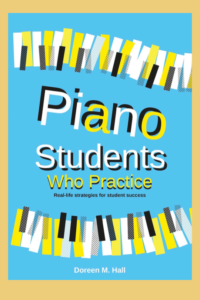
This is a Chapter from my new book. “Piano Students Who Practice.”
Chapter 3: Going with the Flow
But I Don’t Want to Practice
“Good habits formed at youth make all the
difference.”
– Aristotle
I can’t think of one student I have taught who loved to
practice all the time. Everyone seems to have ups and downs
when it comes to practicing. Even the best students have
practice slumps. If I am honest, I do too.
Younger students can have some trouble getting practice in
because parents are too busy to help and supervise. Older
students (including adults) also get busy, overwhelmed, or just
tired of practicing.
As the teacher, I know it’s my job to get my students back on
the practice wagon when they fall off.
Rosemary
September in West Palm Beach is pretty much like any other
time of year.
Hot!
It was the beginning of a brand-new school year, and I had a
few new students coming in for trial lessons. I remember a
certain student named Rosemary. She was just four years old
when her mom (Vanessa) signed her up for lessons. I love
teaching the “littles.” I even wrote a book on the subject.
I require that the parents of preschool students be present
during the lesson and help with practice at home.
Rosemary’s lesson started out well enough, but over time
Mom became somewhat distracted. I could tell that the family
was busy, and Mom was having trouble finding the time to
help Rosemary practice at home.
I knew I had to ask about it. Honestly, this goes against my
nature. I am a recovering people-pleaser, and I hate to ask
anyone to do anything. I hate to make anybody feel bad. I just
want happiness and good vibes at all times.
(Can you relate?)
Nevertheless, I had to speak with Rosemary’s mother about
her practice situation, as uncomfortable as that may be for
me.
“Vanessa, you are doing an amazing job at getting Rosemary
to her lessons every week. That’s got to be a challenge. She’s
always on time, and she even has all of her books ready to
go.”
“Thanks,” she answered. “It’s been a wild couple of weeks at
the office. I know I haven’t been helping Rosey to keep up
with her practice.”
I told her not to worry, that we would do some review and
get back on track. I told Mom that on crazy days when they
didn’t have time to practice, they could do some listening.
Talk about music and maybe even sit at the piano for five
minutes.
There are so many advantages to starting early with piano
lessons. I took some time to reiterate these advantages.
Children who start early can learn to play some very nice
music. Many of my preschoolers go on to develop a superior
sense of rhythm and pitch. Starting early usually helps to
build a sense of self-esteem. I have found that preschoolers
rarely quit the piano because by the time they reach middle
school they play so well that they don’t want to stop.
During the lesson, I took a step back and let Vanessa
participate more. I did my best to make sure that she felt
comfortable with the practice assignment. When they left my
studio, Mom and daughter both had smiles on their faces.
Shelly
A little later that week, I had another student come in. Her
name was Shelly. She had just turned 12 and had been taking
lessons with me for about three years.
I don’t know what happened. She was usually a bouncy,
happy kid. But that day she seemed a little down, a little bit
distracted. I let it go. Who knows, maybe she wasn’t feeling
well or was just having a bad day. Perhaps adjusting to middle
school was a challenge for her.
A few weeks went by, and I knew she wasn’t practicing much,
if at all. So I asked her what was going on.
“Shelly, you’ve been a little off your game lately. Everything
OK?”
I got the shoulder shrug and a deadpan. “I guess.”
“Well, let me know if you want to talk about anything.”
“Let’s get to work,” I said after a moment of silence.
I gave her a couple of choices of what to work on. She was
noncommittal.
In these cases, I remind myself that we all have ups and
downs. I remember how much I love my job and that I am
grateful that Shelly is at her lesson today even if she didn’t
practice.
After giving myself a good (but short) mental talking-to, I
assigned some music and had her start learning it. I let Shelly
know that I expected her to get her work done this coming
week. I told her that if there was some reason she couldn’t
practice, to let me know and we would plan the lesson
accordingly.
In Shelly’s case, thankfully, the slump was short-lived. She got
back on track within a couple of weeks, and we were off and
running. I never did find out what was going on with her. But
that’s OK.
I have learned that even the best students have their ups and
downs. I believe that if they really want to learn to play, I can
find a way to get them back on track and excited again.
Tips and Takeaways
• Being a teacher means being a leader. I can’t always
please everyone or give everyone positive feedback all
of the time. Being kind but truthful with students and
parents helps to establish trust.
• It’s important to nurture a relationship with my
students and their parents/caregivers so that we can
work together to help students succeed.
• Remember the pressures families face and be
understanding.
• Encourage parents and remind them of what a
wonderful opportunity they are providing for their
child.
• Remember that learning to play well is a multiyear
process. Ups and downs are to be expected.
• Sometimes I need to give my student an assignment
and let her know I expect it to be completed. Period.
• I don’t need to know everything going on with a
student. If they want to talk about something, they
will. I focus on teaching music. That’s my job.
• Practicing gratitude helps me remember how blessed
I am to have a job that I love and wonderful people
to work with. It really is what I make of it. I choose to
have a positive attitude toward my work.
“Piano Students Who Practice” is available on Amazon

Comments & Discussion